


Blog
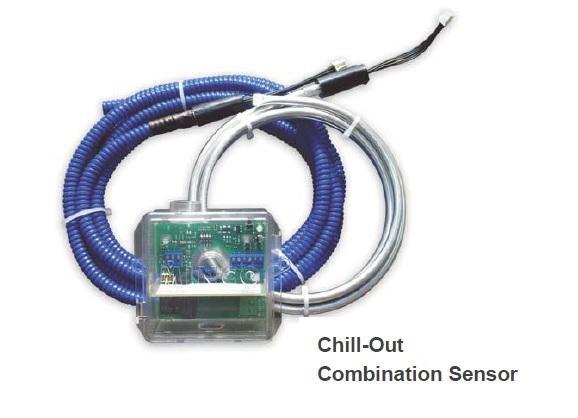
Rethinking HVAC Freeze Protection: Freezestats vs. the Chill-Out™ Combination Sensor
When HVAC freeze protection fails, the consequences can be costly—damaged coils, system downtime, emergency maintenance, and disrupted building operations.
For decades, mechanical freezestats have served as the standard low-temperature cut-out solution in unit ventilators and air handling units. But as HVAC systems evolve to prioritize reliability, efficiency, and lower lifecycle costs, newer solid-state technologies are changing the conversation.
One example is the Chill-Out™ Combination Sensor, an integrated freeze protection device designed to simplify installation, improve response time, and reduce long-term maintenance requirements.
For OEMs, facility managers, and system integrators, the difference between these technologies goes far beyond temperature sensing.
Why HVAC Freeze Protection Matters
Modern HVAC systems are expected to do more than simply heat and cool a space. Today’s commercial, industrial, and educational facilities demand systems that are:
- Reliable
- Easy to maintain
- Fast to install
- Energy efficient
- Cost-effective over the long term
Low-temperature cut-out devices play a direct role in achieving those goals.
In unit ventilators and air handling systems, freeze protection helps prevent coils from freezing under low-temperature conditions. Without proper protection, coil damage can lead to expensive repairs, downtime, and reduced system performance.
As systems become more sophisticated, buyers are increasingly evaluating not just whether freeze protection exists, but how effectively and efficiently it operates.
The Traditional Approach: Mechanical Freezestats
Mechanical freezestats have been widely used for decades due to their simplicity and familiarity.
These devices typically use a vapor-filled capillary tube that reacts to temperature changes and triggers a switch when conditions approach freezing.
While effective, traditional freezestats also introduce several limitations that impact installation, maintenance, and long-term reliability.
Common Challenges with Traditional Freezestats
- Require a separate averaging temperature sensor
- Multiple components increase wiring and installation complexity
- Capillary tubes are vulnerable to kinking and installation damage
- Mounting orientation can affect performance
- Slower response times compared to modern solid-state sensors
- Greater potential for installation errors and replacement costs
In many cases, the installation and maintenance burden exceeds the cost of the component itself.
A Modern Alternative: Chill-Out™ Combination Sensor
The Chill-Out™ Combination Sensor replaces multiple components with a single integrated solid-state device designed specifically for HVAC freeze protection applications.
Instead of relying on mechanical capillary tubing, Chill-Out uses integrated circuit (IC) sensors spaced along the probe to continuously monitor temperature conditions and detect cold spots every 12 inches.
The result is faster, more accurate freeze protection with simplified installation and improved durability.
Integrated Functions Include
- Low-temperature cut-out protection
- Continuous averaging temperature sensing
- Built-in control electronics
- Digital output for system integration
- Optional visual alarm indication
Because sensing and control functions are integrated into one device, system design becomes simpler and easier to maintain.
Why Faster Response Time Matters
In freeze protection applications, response time directly impacts system safety and equipment protection.
Mechanical freezestats can take up to two minutes to react to changing conditions. During rapid temperature drops, that delay can increase the risk of coil damage.
Chill-Out responds in under 30 seconds, allowing systems to react more quickly to developing freeze conditions.
This faster response improves protection while helping maintain more stable system operation.
Chill-Out detects cold spots every 12 inches along the probe, providing more comprehensive coverage than traditional capillary-based designs.
Simplifying Installation and Reducing Labor
Installation is often where the biggest operational differences become apparent.
Traditional freezestats require careful routing and handling to avoid damaging the capillary tube. They also require separate sensors, additional wiring, and specific mounting orientations.
This increases:
- Installation time
- Labor costs
- Risk of installation errors
- Replacement frequency during commissioning
Chill-Out simplifies the process through a more rugged, installer-friendly design.
Installation Advantages of Chill-Out
- Durable aluminum construction resists bending and handling damage
- Can be mounted horizontally, vertically, or diagonally
- Combines multiple sensing functions into one device
- Reduces wiring complexity
- Removable probe simplifies setup and maintenance
In retrofit applications or projects with limited access, reducing component count can significantly decrease installation labor and commissioning time.
Built for Long-Term Reliability
Construction differences also play a major role in long-term performance.
Traditional freezestats use thin copper capillary tubing that can be easily damaged during installation or service.
Chill-Out uses thicker aluminum tubing designed for demanding HVAC environments, improving durability and reducing the likelihood of premature failure.
Fewer damaged components mean:
- Less maintenance
- Fewer callbacks
- Lower replacement costs
- Improved long-term reliability
Lower Total Cost of Ownership
When evaluating HVAC freeze protection solutions, upfront component pricing tells only part of the story.
Labor, maintenance, replacement frequency, and downtime all contribute to total lifecycle cost.
By:
- Reducing installation time
- Eliminating secondary sensors
- Simplifying wiring
- Improving durability
- Minimizing installation errors
The Chill-Out™ Combination Sensor can help reduce overall system costs across the life of the equipment.
For OEMs and facility owners focused on reliability and maintainability, integrated solid-state sensing technology offers clear operational advantages over traditional mechanical freezestats.
The Bottom Line
As HVAC systems continue evolving toward smarter, more maintainable designs, component simplification is becoming a competitive advantage.
While traditional freezestats remain familiar solutions, integrated technologies like the Chill-Out™ Combination Sensor offer meaningful improvements in installation efficiency, response time, durability, and long-term reliability.
For engineers, contractors, OEMs, and facility operators evaluating HVAC freeze protection strategies, solid-state combination sensors represent a modern approach to reducing complexity while improving system performance.



