


Blog
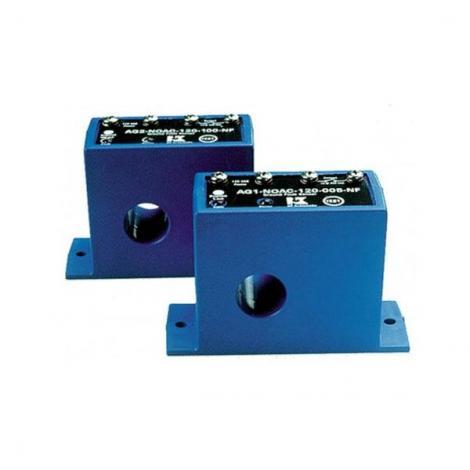
Ground Fault Sensing and Protection: A Practical Guide for Industrial Systems
Every industrial electrical system is designed so that current flows out to a load and returns along a known path. A ground fault is what happens when some of that current finds a different way home — leaking through insulation, moisture, or a person, and returning to earth instead of through the circuit. Left undetected, even a small ground fault can injure someone, damage expensive equipment, or shut down a process at the worst possible moment.
The good news is that ground faults are detectable long before they become dangerous. In this guide we'll look at how ground fault sensing works, the trip thresholds that matter, and how to turn a detected fault into fast, reliable protection for both people and processes.
What Is a Ground Fault Sensor?
A ground fault sensor watches for current that has gone missing. In a healthy circuit, the current leaving on the supply conductors exactly equals the current returning. When some current leaks to ground, that balance is broken — and that imbalance is the signal a ground fault sensor is built to catch.
Most sensors do this with a toroid: a ring of magnetically permeable metal wound with many turns of fine wire, placed around the conductors. As long as supply and return currents are equal, their magnetic fields cancel and the toroid sees nothing. The moment they differ, the toroid produces a small voltage proportional to the imbalance, and that voltage triggers protective action. It's an elegant approach because it measures the fault directly rather than inferring it from total load.
Protecting People
The most important reason to detect ground faults is human safety. It takes surprisingly little current passing through the body to cause harm. Based on OSHA figures, the physiological response to current is roughly:
- 1 mA — a barely perceptible tingle
- 5 mA — a slight shock; unpleasant but a person can let go
- 6–25 mA — painful shock with loss of muscular control
- 9–30 mA — the "freezing current" range, where a person may be unable to release the conductor
- 50–150 mA — extreme pain, possible respiratory arrest
- 1,000 mA and above — ventricular fibrillation and probable death
Because muscular control is lost well below levels that stop the heart, personnel-protection devices are designed to trip fast and low. For circuits where direct human contact is possible — bathrooms, kitchens, outdoor and wet locations, construction sites, pool and marina areas — recent editions of the National Electrical Code commonly specify a trip threshold around 6 mA. As always, the governing code edition and your local inspector have the final say, so verify the requirement for your jurisdiction.
Protecting Processes and Equipment
Not every ground fault is a shock hazard, but many are still expensive. Motors and transformers develop small insulation imperfections over time, often leaking a few milliamps through aging varnish. That low-level leakage tends to grow, and left unchecked it can escalate into arcing that destroys windings. Heat trace cables leak small currents to earth, especially over long runs, and machinery that combines heaters, motors, and transformers can accumulate leakage from many sources at once.
For equipment protection, a common trip point is around 30 mA — high enough to ride through normal background leakage, low enough to catch a developing fault before it does real damage. In some supervised industrial settings, the code even allows a detected fault to raise an alarm rather than immediately disconnecting, so an operator can bring a critical process to an orderly stop instead of tripping in the middle of a batch.
Where to Monitor Matters
One of the most important design decisions is where you place the sensor. The best location is usually close to the individual load rather than far upstream at a main. Monitoring a single load lets you set a lower, more sensitive trip point, because you're not summing the harmless leakage of dozens of downstream devices. Monitor everything from one central point and those small leakage currents add up, forcing you to raise the threshold and reducing your protection where it counts.
Environmental conditions matter too. Moisture increases leakage current — an overhead gantry crane that leaks a few milliamps when dry can leak far more in damp conditions — so design with real-world operating conditions in mind, not just the nameplate.
Turning Detection Into Protection
Detecting a fault is only useful if the system does something about it. Two approaches are common:
Shunt trip circuit breakers. When the sensor detects a fault, it energizes a solenoid that opens the breaker remotely, cutting all power. Because the breaker must then be reset by hand, there's no chance of accidental re-energization until someone has investigated.
Magnetic contactors. Here the ground fault relay opens the contact feeding the contactor coil, dropping out the load. A "three-wire" control scheme — like a standard motor start/stop station — requires a deliberate restart after a trip, which prevents equipment from cycling back on automatically.
The relay output itself can be configured to suit the application. Auto-reset outputs return to normal once the fault clears, while latching outputs stay tripped until manually reset, typically with an integral test button and provision for a remote reset. A normally energized (fail-safe) output also trips on loss of power, so a wiring failure defaults to the safe state. For applications that need precise measurement of very small faults, some sensors provide an industry-standard 4-20 mA output proportional to the fault current, giving you accurate readings even below 5 mA.
Common Applications
Ground fault sensing shows up anywhere leakage threatens people or uptime: snow- and ice-melting systems in walkways, semiconductor and wafer-production machinery, heat-traced piping, overhead cranes, fuel-dispensing stations with emergency disconnects, and countless heating and motor circuits across industrial plants.
Specify the Right Protection with MOD-TRONIC
Choosing the right trip point, monitoring location, output type, and reset behavior is what separates protection that quietly does its job from protection that nuisance-trips or, worse, doesn't trip when it should. MOD-TRONIC stocks a full range of ground fault sensors built to protect people, products, and processes, along with the current sensors and transducers, current switches, and current indicators that round out a complete current-monitoring strategy.
If you're specifying protection for a new system or tightening up an existing one, our experienced staff is ready to help you match the right sensor to your application. Give us a call at 1-800-794-5883 or request a quote through our website, and we'll help you get it right the first time.



