


Blog
Demystifying the "NTC Dip": Why Your PTC Thermistor’s Resistance Drops Before It Spikes
If you are bench-testing a new batch of motor protection PTC thermistors, you might run into a scenario that leaves you scratching your head. You connect your digital multimeter, apply a bit of heat, and watch the screen. Instead of the resistance climbing immediately, the numbers actually start going down.
Your first thought might be: "Did the factory accidentally send us NTC thermistors instead of PTCs?"
It is a completely reasonable conclusion to draw, but do not send them back just yet. What you are witnessing is not a manufacturing defect—it is a completely normal, built-in physical characteristic of switching-type ceramic thermistors.
Here is a breakdown of why this initial resistance drop happens, exactly when the curve turns around, and how to properly test for it on your bench.
Understanding the Parabolic Curve and Initial Resistance Dip
Positive Temperature Coefficient (PTC) thermistors are famous for their ability to act like solid-state switches. When they hit a critical threshold temperature, their electrical resistance suddenly explodes upward, effectively cutting off current or triggering a safety relay to protect expensive motor windings.
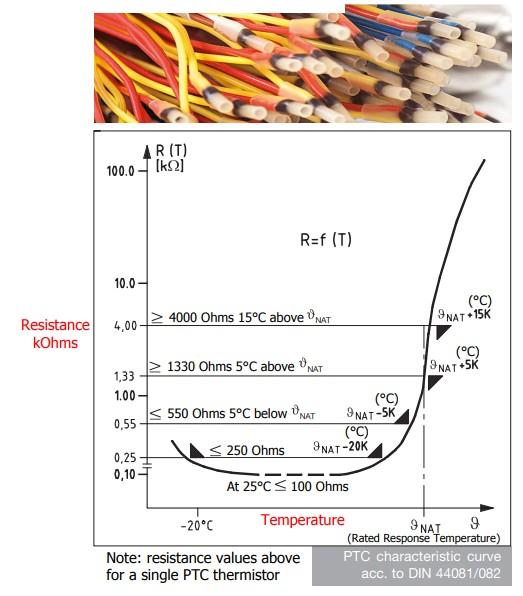
However, the material used to build these components—typically a barium titanate ceramic—does not behave like a straight line on a graph. Instead, it follows a subtle parabolic curve at lower temperatures.
When you heat a PTC sensor from room temperature (25°C), it initially exhibits a weak Negative Temperature Coefficient (NTC) behavior. This means that for the first several dozen degrees of heating, the internal resistance will gradually decrease until it reaches its absolute lowest point, known as the minimum resistance value (Rmin).
The PTC Turnaround Temperature: Where the Resistance Switch Happens
If your inventory consists of standard motor protection thermistors with nominal response temperatures anywhere between 130°C and 180°C, you might wonder how far you have to heat them before they finally start acting like PTCs.
The good news is that you do not have to wait until you reach the actual trip threshold to see the turnaround. Across this entire range of sensors, the inversion point remains remarkably consistent:
- Below 90°C: The sensor is in its "NTC phase." Resistance is steadily dropping.
- The 90°C to 110°C Window: This is the turnaround zone. The temperature coefficient flips from negative to positive. The resistance stops falling, levels out, and begins its upward climb.
- Above 110°C: The sensor enters its true "PTC phase." Resistance recovers back past its room-temperature baseline and prepares for its massive exponential spike as it nears the rated trip point.
Whether you are testing a single-element sensor or a triple-element triplet wired in series, this 90°C to 110°C window is exactly where you will observe the resistance change directions.
How to Correctly Bench Test a Switching PTC Thermistor Curve
Because the initial resistance drop is subtle and the subsequent PTC spike is incredibly fast, standard workshop tools can easily miss the turnaround point entirely. If you want to log the full curve for your quality control records, follow these three best practices:
1. Avoid Uncontrolled Heat Guns
An open flame or a high-powered industrial heat gun dumps thermal energy into the sensor bead too quickly. The localized heat rises so fast that the internal ceramic core experiences a severe thermal lag. By the time your multimeter registers a change, you will have blown right past the 100°C turnaround zone. Instead, use a regulated, slow-heating liquid or sand bath.
2. Watch Your Multimeter Voltage and Prevent Self-Heating Error
Always check the measuring voltage of your testing equipment. To get an accurate reading on a switching thermistor, the applied testing voltage should be strictly capped at 2.5V DC or lower (ideally using a low-current mode under 1mA). If your test meter pumps too much current through the circuit, it will induce "self-heating" inside the ceramic bead, masking the true turnaround temperature and skewing your data.
3. Log Continually Across the Temperature Spectrum
Do not just take a reading at room temperature and another at the final trip point. To truly see the physics at work, record your resistance readings at 25°C, 60°C, 100°C, and then every 5°C as you climb toward the sensor's rated threshold. You will see a perfect, predictable map of a healthy, functioning PTC sensor.
Source Reliable Overheating Protection Components
Understanding how these components behave ensures your machinery stays safe without premature tripping. If you need robust solid-state protection for your equipment, explore our complete line of UL-recognized single-element and triple-element assemblies by visiting our dedicated PTC Thermistors for Electric Motors product page.



